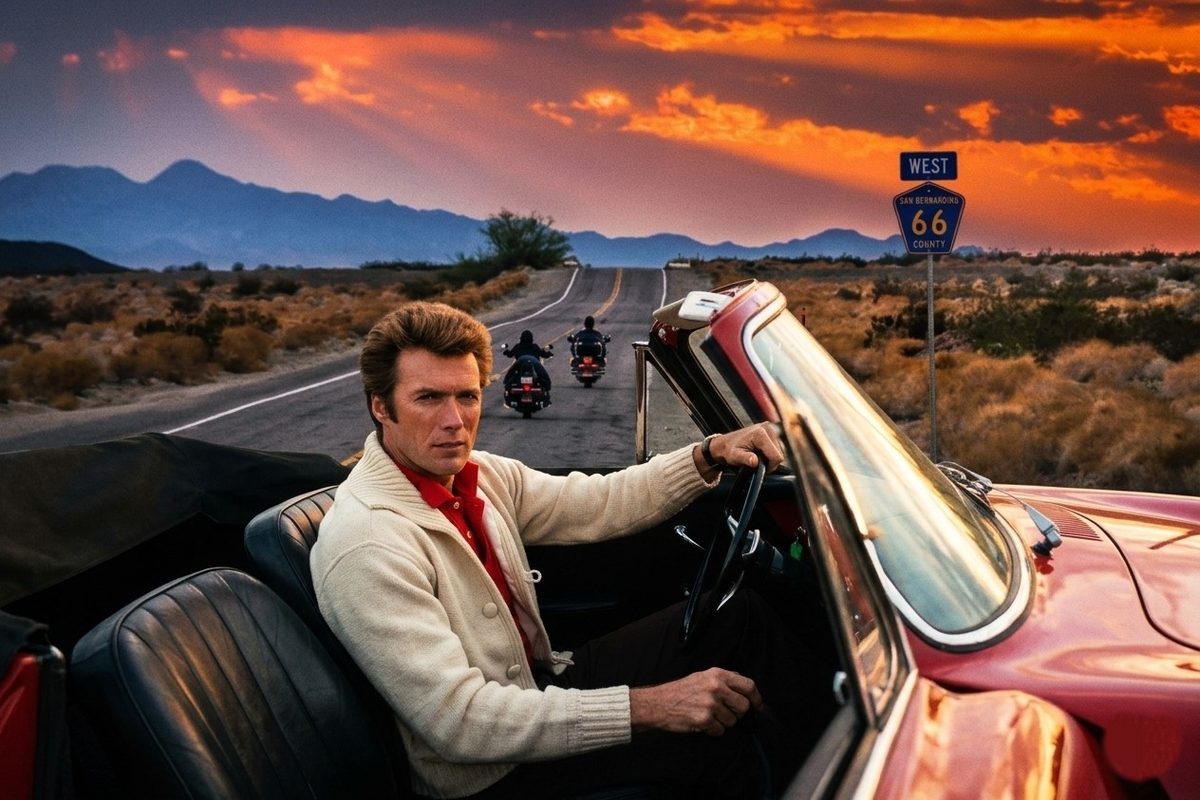
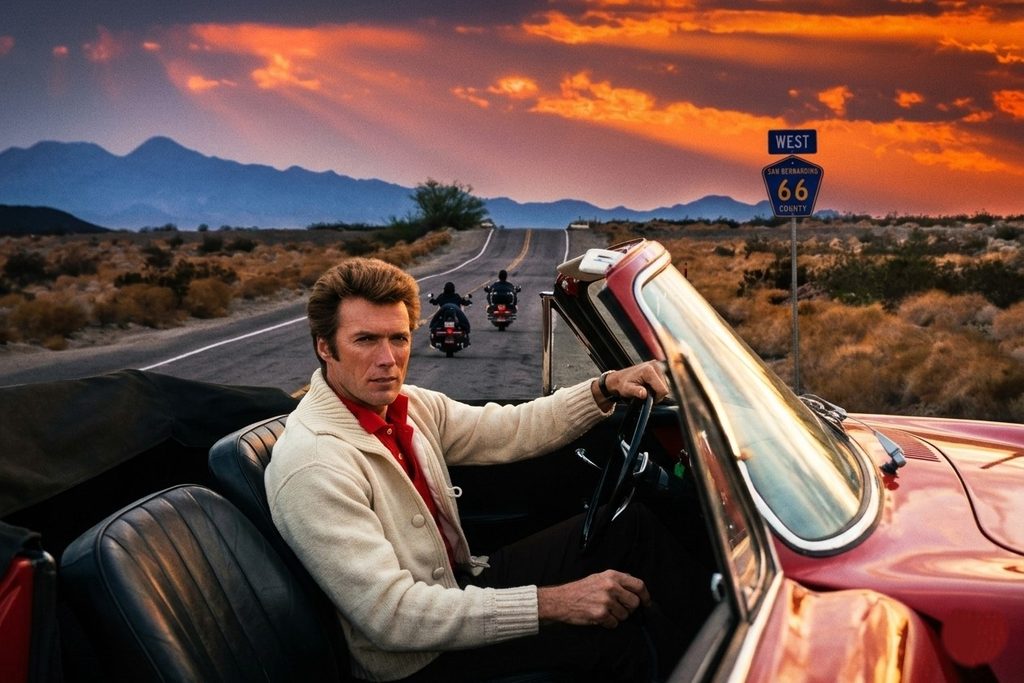
The desert heat was finally breaking as the sun dipped below the distant peaks, painting the sky in violent streaks of crimson and gold. Behind the wheel of the red convertible, Clint kept his eyes fixed on the empty expanse of Route 66, the low, steady thrum of the engine keeping time with his thoughts. In the distance, two lone motorcyclists kicked up thin trails of dust as they faded into the horizon, their tail lights disappearing toward the West. Out here, where the county lines blurred into the open road, there were no schedules to keep or places he had to be—just the wind, the fading light, and the quiet freedom of chasing the sunset.
Some links on this website are eBay affiliate links.
Vintage Red 1965 Porsche 356 __
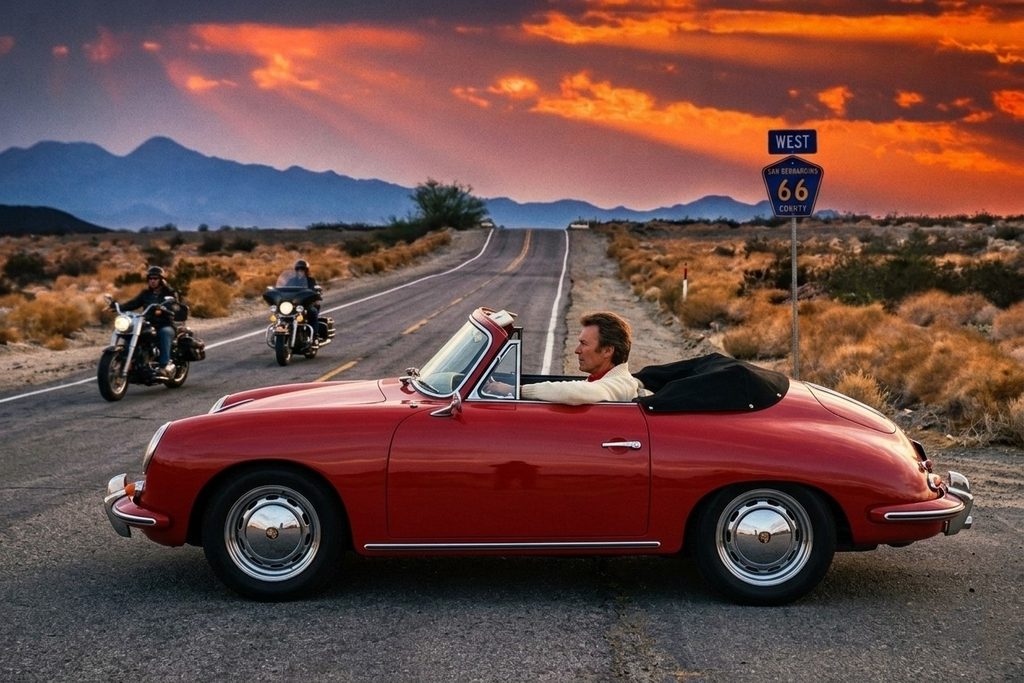
The desert sun dipped low, painting the sky in deep streaks of amber and violet as Clint pulled his red Porsche 356 onto the shoulder of Route 66. In the distance, the low, rhythmic rumble of approaching motorcycles hummed against the quiet expanse of the San Bernardino County line. He rested his arm on the door, letting the cool evening air cut through the lingering heat of the asphalt, watching the two riders trace the gentle curves of the empty road. It was the kind of timeless American twilight where the destination mattered far less than the open road ahead and the steady purr of a well-tuned engine.

The year is 1965. For 35-year-old Clint Eastwood, it is a time of exhausting duality, tectonic professional shifts, and a quiet, simmering chaos behind closed doors. The towering 6’4” actor stands at a defining crossroads, straddling the worlds of predictable American television and an explosive, dangerous new kind of international cinema.
The Professional Life: From Ramrod to Global Icon
In Hollywood, Clint is feeling the suffocating weight of routine. For seven years, he has worn the dusty boots of Rowdy Yates on the hit CBS series Rawhide. By 1965, the long prime-time cattle drive is sputtering toward its final episodes. When lead actor Eric Fleming leaves the show, Clint is briefly promoted to trail boss, but the writing is on the wall—the network is ready to cancel the series. To Hollywood executives, Clint is a reliable, clean-cut television actor. A “day player” who had finally found a steady paycheck.
But a secret revolution is already underway.
A year prior, Clint had flown to Spain and Italy during his Rawhide hiatus to film a low-budget movie with an unknown Italian director named Sergio Leone. He had taken the role out of sheer boredom, demanding a few thousand dollars and a chance to escape CBS.
Now, in late 1965, the shockwaves of that choice are crashing onto the European continent. A Fistful of Dollars has exploded across Europe, transforming the clean-cut TV cowboy into something entirely different: The Man with No Name.
Clint spends 1965 stepping back onto Leone’s gritty, sun-baked European sets to film the sequel, For a Few Dollars More. On set, the contrast is stark. There are no luxurious Hollywood trailers. Clint walks through the heat wearing a cheap, unwashed green poncho he bought himself, squinting through the stinging smoke of a black Tuscan cigar—a habit he hates, but one that Leone insists defines the character. He watches Leone orchestrate long, agonizing silences and extreme close-ups, backed by the haunting, operatic, whistle-heavy scores of Ennio Morricone.
By the time For a Few Dollars More premieres in Italy in December 1965, Clint Eastwood is the biggest movie star in Europe. Yet, due to a tangle of legal and distribution rights, these movies haven’t even been released in the United States yet. Clint lives a bizarre double life: a fading TV actor in Los Angeles, and an untouchable, mythical god of cinema in Rome.
The Personal Life: The Illusion of Domesticity
Back home in California, Clint’s personal life is a complex web of carefully managed appearances and turbulent undercurrents.
To the public, he is happily married to Maggie Johnson, whom he wed in 1953. They are a picture-perfect Hollywood couple, enjoying the fruits of Clint’s Rawhide success. But beneath the surface, the marriage is plagued by a reality that would characterize much of Clint’s private life: relentless infidelity and emotional distance.
Clint’s rugged independence on screen isn’t an act; he lives with a stoic, fiercely guarded autonomy. He spends hours escaping the domestic pressures of Los Angeles by retreating into physical fitness, jazz music, and long drives up the California coast. It is during this era that his obsession with the rugged, foggy coastline of Carmel-by-the-Sea deepens—a place that offers him a sanctuary away from the prying eyes of studio executives and the complications of his own making.
He is a man navigating a profound transition. He knows the studio system that birthed him is dying, and his marriage is fragile. But as 1965 draws to a close, the final frames of Rawhide are shot, and the American film industry is finally waking up to the box-office thunder echoing from Europe.
Clint Eastwood is about to bring the “Spaghetti Western” home to America, and Hollywood will never be the same.